
Burkina Faso Frees Detained Nigerian Air Force Crew After Tinubu’s Diplomatic Intervention
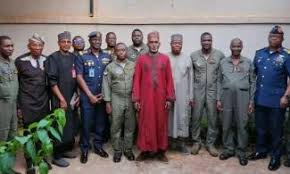
Burkina Faso has released Nigerian Air Force (NAF) personnel who were detained after their aircraft made a forced landing in the Sahelian country nearly two weeks ago, following high-level diplomatic engagement by the Federal Government of Nigeria.
The release came after President Bola Ahmed Tinubu dispatched a delegation led by the Minister of Foreign Affairs, Yusuf Tuggar, to engage Burkina Faso’s junta leader, Captain Ibrahim Traoré, in Ouagadougou on Wednesday.
A statement issued by Alkasim Abdulkadir, spokesperson to the foreign affairs minister, confirmed that both countries amicably resolved the issue surrounding the Nigerian military pilots and crew.
The NAF personnel were detained after the Confederation of Sahel States (AES) described the aircraft’s landing as an “unfriendly act carried out in defiance of international law.” However, the Nigerian Air Force maintained that the landing was purely precautionary, prompted by a technical concern observed mid-flight.
According to the NAF, the aircraft landed in Bobo-Dioulasso—the nearest available airfield—in line with standard aviation safety procedures and internationally accepted protocols.
While unconfirmed reports last week suggested that the personnel had been released, Tuggar had clarified that the soldiers were still being held at the time, noting that diplomatic efforts were ongoing to secure their freedom.
Wednesday’s talks eventually led to a breakthrough, with Abdulkadir stating that Tuggar conveyed a message of solidarity and fraternity from President Tinubu to Traoré. The meeting also provided an opportunity for both sides to explore ways of deepening bilateral relations and strengthening regional integration.
Discussions during the engagement focused on enhancing political, security and economic cooperation, particularly in addressing shared security challenges across the Sahel and promoting collective action through existing sub-regional mechanisms.
“Both sides agreed to sustain regular consultations and pursue practical measures to deepen bilateral cooperation and regional integration, reflecting a shared resolve to promote peace, unity, and stability in the sub-region,” Abdulkadir said.
Members of the Nigerian delegation included the Director-General of the National Intelligence Agency (NIA), Mohammed Mohammed; the Chief of Policy and Plans of the Nigerian Air Force, Air Vice Marshal A. Y. Abdullahi; Nigeria’s Permanent Representative to the Economic Community of West African States (ECOWAS), Ambassador Olawale Awe; and the Chief of Protocol at the Ministry of Foreign Affairs.
The incident occurred against the backdrop of heightened diplomatic and security sensitivities in the Sahel following the withdrawal of Burkina Faso, Mali and Niger from ECOWAS and the formation of the AES. Relations between the bloc and neighbouring countries have remained strained, with military governments in the Sahel adopting a cautious posture towards external military movements.
Nigeria, which has consistently emphasised regional cooperation and dialogue, has maintained that the NAF aircraft’s landing was a routine safety decision rather than a hostile or unlawful act. The successful resolution of the matter through diplomacy underscores Abuja’s preference for engagement and peaceful conflict resolution in managing complex regional security dynamics.
Leave a reply


Albarka 89.9 FM broadcast opinions and debates in an open, diverse and unbiased style, with the aim of educating and empowering the public.
We also place emphasis on neglected perspectives and discussion on important local, national and global issues, reflecting values of peace, social justice, human rights, democracy, multiculturalism, freedom of expression and social change.
Our arts and music programming cover a wide spectrum of expressions and reflect the diverse culture of our listeners