
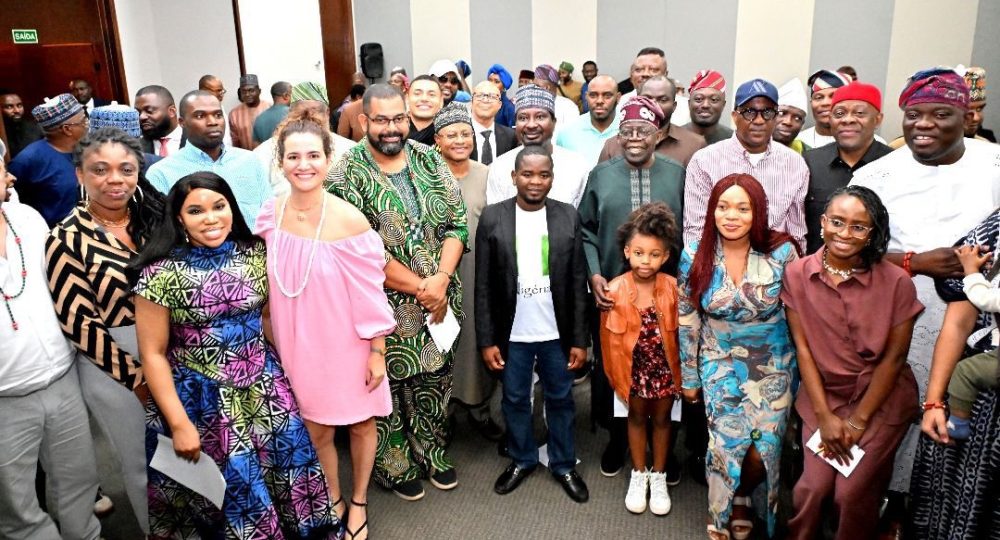
Tinubu Pledges Tech-Driven Growth, Food Security as He Courts Diaspora in Brazil
By Abiola Adigun
President Bola Ahmed Tinubu has pledged to fast-track Nigeria’s economic transformation through technology, innovation, and food security, urging Nigerians in the diaspora to see themselves as “co-architects of a new Nigeria.”
Speaking in Brasília on Tuesday during an interactive session with Nigerians resident in Brazil, Tinubu said his administration is determined to learn from Brazil’s economic transformation and adapt its success model to Nigeria.
“Once upon a time, Nigeria and Brazil stood on the same level. Look at Brazil today—its technology, its food systems. We must ask ourselves: what do they have that we don’t? We have the brains, the energy, and the youth. Now, we must act,” the President declared.
Brazil, now Latin America’s largest economy, shares deep historical and cultural ties with Nigeria, especially through centuries of migration and Afro-Brazilian heritage. Economists often draw parallels between the two nations, both of which once had similar agricultural strengths.
Dr. Ayo Teriba, CEO of Economic Associates, explained in an interview that “Brazil leveraged agribusiness and technology to pull millions out of poverty. Nigeria can replicate this by modernizing its food systems, deploying precision agriculture, and integrating technology into governance and commerce.”
Tinubu’s emphasis on food security echoes his administration’s Renewed Hope Agenda, which prioritizes domestic food production to reduce dependency on imports. Nigeria has struggled with spiraling food inflation—reaching nearly 40% in mid-2025—due largely to insecurity in farming regions and supply chain disruptions.
Addressing the vibrant Nigerian community in Brazil, Tinubu described them as “the pride of our nation,” insisting that diaspora Nigerians are essential to his vision of national renewal.
Chika Emmanuel, Chairman of Nigerians in Diaspora in Brazil, highlighted ongoing contributions:
“Here through the diaspora, we would like to be a channel to national development. In the past year alone, the number of Nigerian PhD students here has grown from just three to nearly 300, most on scholarships. We want to return home equipped to contribute to agriculture, infrastructure, and education.”
The diaspora remains one of Nigeria’s most important economic lifelines, remitting $22 billion in 2023 according to World Bank data—more than foreign direct investment and oil revenues combined.
Tinubu acknowledged the economic pain caused by subsidy removal and forex reforms, likening them to “bitter medicine” necessary for long-term health.
Governor Uba Sani of Kaduna State, who was part of the delegation, defended the reforms:
“In the past, it was almost impossible to convince any investor to come to Nigeria. But just last year, Mr. President cleared a $7 billion forex backlog, a major intervention. Investors now know they can bring in capital and repatriate profits without hurdles.”
Economic analysts, however, caution that while the reforms may improve investor confidence, they have also fueled hardship for ordinary Nigerians. “The policies are bold, but the government must urgently scale up safety nets,” said Dr. Olusola Bello, a Lagos-based development economist.
Speaker of the House of Representatives, Rt. Hon. Tajudeen Abbas, called the meeting with the diaspora “a historic moment” that rekindles Nigeria’s long-standing bonds with Brazil.
Brazil hosts one of the largest populations of Afro-descendants outside Africa, many tracing roots to Nigeria. According to Prof. João Reis, a Brazilian historian of Afro-Atlantic relations, “strengthening Nigeria-Brazil cultural and economic exchanges is not only symbolic, it is strategic. Both countries can gain from joint research in agriculture, renewable energy, and creative industries.”
President Tinubu also expressed support for an upcoming cultural voyage involving Nobel laureate Wole Soyinka, describing it as a reminder that “if Soyinka, at over 90, can still dream and act, then we have no excuse.”
The meeting, coordinated by Abike Dabiri-Erewa of the Nigerians in Diaspora Commission, was attended by top Nigerian officials, including Senate Deputy President Barau Jibrin, Governors Caleb Mutfwang and Uba Sani, and Minister of Information Mohammed Idris.
Tinubu urged patience regarding requests for new consulates in São Paulo and other cities, saying Nigeria is “carefully managing scarce resources to sustain foreign missions.”
“We must bring Nigeria to the forefront of Africa’s progress—driven by technology, food sovereignty, and the courage to change our destiny. The dream must be realized. The time is now”,
the President said.
Leave a reply


Albarka 89.9 FM broadcast opinions and debates in an open, diverse and unbiased style, with the aim of educating and empowering the public.
We also place emphasis on neglected perspectives and discussion on important local, national and global issues, reflecting values of peace, social justice, human rights, democracy, multiculturalism, freedom of expression and social change.
Our arts and music programming cover a wide spectrum of expressions and reflect the diverse culture of our listeners