

Police, EFCC Turn the Tables Against Foreign Cybercriminals in Landmark Convictions.
By Abiola Adigun
For years, the narrative of cybercrime in Nigeria has been dominated by the image of young Nigerians—derisively tagged “Yahoo Boys”—being paraded by law enforcement agencies. But in a historic twist, Nigerian courts are now convicting foreign nationals for running sophisticated internet fraud networks on Nigerian soil, flipping the script on a country long stigmatized as a hub for digital crime.
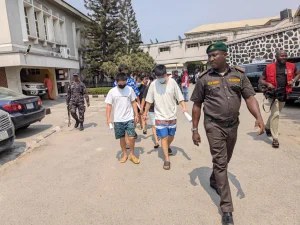
The Nigeria Police Force announced this week the conviction of 21 foreign nationals, including Chinese, Malaysian, and Filipino citizens, linked to a high-level cybercrime syndicate uncovered in Abuja late last year. The syndicate’s operations, according to the Force, ranged from large-scale phishing and hacking schemes to identity theft and online impersonation designed to target victims across Africa, Asia, and Europe.
Police Public Relations Officer, DCP Muyiwa Adejobi, recalled the November 3, 2024 raid on a sprawling building in the Jahi district of Abuja. Backed by digital forensic experts, the operation netted 130 suspects—113 of them foreigners—and uncovered “evidence of massive online fraud networks capable of destabilizing national security and economic stability.”
After months of trial, 21 were convicted on August 1, 2025, with others still facing prosecution in collaboration with the Ministry of Justice. “This is a clear message,” Inspector-General of Police, Kayode Adeolu Egbetokun, said, “Nigeria is not, and will never be, a safe haven for cybercriminals—whether homegrown or foreign.”
In Lagos, the Economic and Financial Crimes Commission (EFCC) secured separate convictions of 12 Filipino nationals involved in terrorism-linked internet fraud and identity theft. Justice Yellin Bogoro of the Federal High Court sentenced each to one year in prison, with an option of a N1 million fine, and ordered their deportation upon completion of the sentence.
“These convicts exploited our young people, training them in cyber-enabled crime and using Nigeria as a launchpad for global scams,” EFCC Chairman Ola Olukoyede said in a statement. “We are intensifying our operations not just against local fraudsters, but against foreign collaborators who think they can come here to corrupt our youths and tarnish our image.”
The United Nations Office on Drugs and Crime (UNODC) has repeatedly warned about the growing global cybercrime economy and its appeal to unemployed youth. “The transnational nature of cybercrime means no country is immune,” a UNODC West Africa spokesperson told reporters. “Nigeria’s recent convictions show a commendable willingness to tackle both domestic and foreign actors. This must continue, with prevention programs targeting vulnerable youth.”
Interpol’s Cybercrime Directorate echoed similar sentiments, calling Nigeria’s action “a significant deterrent.” “For too long, foreign syndicates have viewed Africa as a low-risk base of operations. These convictions show the tide is turning,” an Interpol statement said.
Nigeria’s internet fraud problem has been a stain on its global reputation, magnified by high-profile cases like Ramon “Hushpuppi” Abbas, the Instagram celebrity jailed in the U.S. for multimillion-dollar cyber fraud. His arrest in Dubai in 2020, along with his associates, reinforced stereotypes about Nigerian cyber criminality.
Now, the arrest and conviction of foreign perpetrators in Nigeria may help rewrite that narrative. “For decades, Nigerians bore the brunt of a bad name,” said Lagos-based cybercrime analyst Funke Adebayo. “Ironically, some of that name was earned through collaborations with foreigners who are now being unmasked here.”
Security experts say the convictions could strengthen Nigeria’s case for deeper international cooperation in cybercrime prevention. The government is already working with Interpol, the FBI, and Europol to share intelligence and disrupt cross-border scam networks.
But the challenge remains daunting. EFCC data shows hundreds of young Nigerians are still arrested yearly for internet-related offences—often recruited by foreign syndicates seeking local expertise and digital access points.
The EFCC’s Olukoyede insists that aggressive prosecution must be matched with economic alternatives for at-risk youth: “We can’t arrest our way out of cybercrime. We must make honest work more rewarding than fraud.”
As the trials of the remaining suspects continue, Nigerian law enforcement agencies are signaling a new era—one where the country is not only a target of cybercrime crackdowns abroad, but also a frontline enforcer bringing foreign criminals to justice at home.



Leave a reply


Albarka 89.9 FM broadcast opinions and debates in an open, diverse and unbiased style, with the aim of educating and empowering the public.
We also place emphasis on neglected perspectives and discussion on important local, national and global issues, reflecting values of peace, social justice, human rights, democracy, multiculturalism, freedom of expression and social change.
Our arts and music programming cover a wide spectrum of expressions and reflect the diverse culture of our listeners