
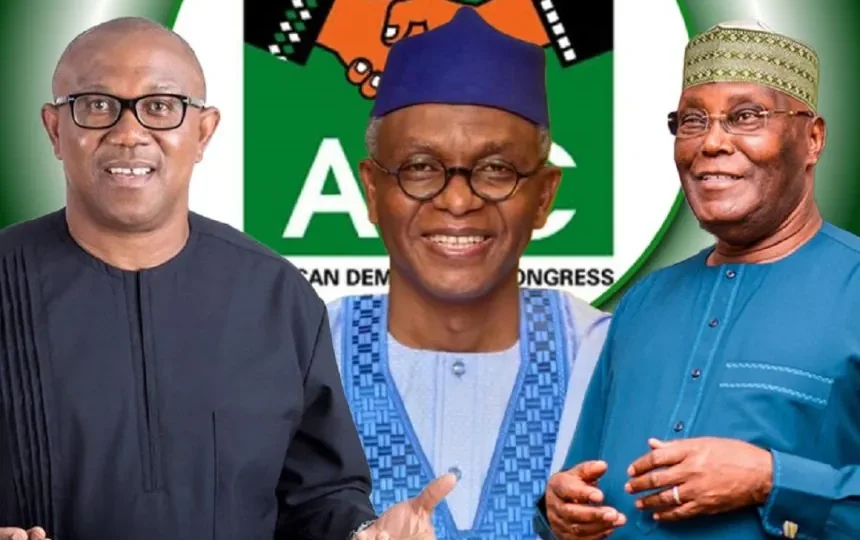
Nigeria’s New Political Coalition: A Union of Self-Interest, Not New Ideals
By Abiola Adigun
The new Coalition formed by Nigeria’s political elites, nearly two years ahead of the next general elections, is drawing attention — not for its promise of fresh ideas, but for its familiar faces and recycled ambitions.
At the heart of this coalition is a mission to unseat President Bola Ahmed Tinubu at the end of his first term. The alliance brings together prominent figures from the Peoples Democratic Party (PDP), the Labour Party (LP), and other smaller parties.They have adopted the African Democratic Party as their Political Party. But a closer look reveals that this new coalition is less about ideology and more about personal ambition and political survival.
Leading the charge is former Vice President Atiku Abubakar, a PDP stalwart and perennial presidential candidate. Joining him is Peter Obi, who ran under the Labour Party in 2023 after previously serving as a PDP governor. Obi’s last campaign gained momentum from disillusioned youths and members of Pentecostal churches, many of whom opposed the Muslim-Muslim ticket of the All Progressives Congress (APC).
Also in the mix is Senator David Mark, a retired military officer and former Senate President; Rauf Aregbesola, former Osun State Governor and one-time Minister of Interior under President Buhari; and Nasir El-Rufai, the former Governor of Kaduna State and one-time key ally of President Tinubu. Notably, El-Rufai was a vocal supporter of Tinubu during the 2023 campaign, even accompanying him to Chatham House in London to defend the controversial ticket.
Chief John Odigie-Oyegun, former APC Chairman and Governor of Edo State, is also backing the new formation. His fallout with Tinubu during the early days of the APC is well known, adding personal undertones to his current stance.
The coalition has anchored its criticism of the Tinubu administration on the growing economic hardship — rising food prices, high petrol costs, and a weakened Naira. But critics argue that these leaders have failed to articulate a clear alternative vision, beyond pointing fingers at the challenges of reform.
Ironically, the government has been praised by some international observers for initiating bold reforms. Upon assuming office, President Tinubu swiftly removed the petroleum subsidy — a system widely known to be riddled with fraud by entrenched interests. He also collapsed the multiple exchange rate regime, long exploited by the wealthy for arbitrage.
In taxation, the administration has moved to broaden the tax base by targeting wealthy individuals and corporations, while offering reliefs and incentives to small businesses. On social welfare, it has expanded support for the elderly and petty traders, introduced a student loan scheme for indigent youths, and launched a National Credit Corporation to provide easier credit to middle-class Nigerians.
In agriculture, the government is rolling out a long-overdue transformation. With the recent importation of 2,000 tractors from Belarus at subsidized rates, it aims to shift agriculture from subsistence to a business-driven model — creating value across the production chain and boosting food security.
With petroleum subsidies gone and market-driven exchange rates in place, government revenue has increased, creating room for investment in infrastructure and long-term development.
Still, the opposition coalition insists these reforms have only deepened poverty and hardship for ordinary Nigerians. The group claims that five serving governors are ready to join its ranks — a signal that it may soon control considerable political and financial muscle, particularly at the grassroots.
President Tinubu, however, appears unfazed. He has dismissed the opposition bloc as lacking the cohesion and vision needed to challenge his mandate, boasting that he himself is a “grandmaster of coalition politics.”
Indeed, unlike the structured merger that birthed the APC in 2013 — uniting parties such as the Congress for Progressive Change (CPC), the Action Congress of Nigeria (ACN), and the All Nigeria Peoples Party (ANPP) — this new alliance resembles a loose gathering of individuals with varying agendas rather than a unified political movement.
The coming months will be crucial. For the new coalition to stand a chance, it must evolve from a platform of grievances into a credible political machine with grassroots presence, internal discipline, and a clear ideological direction.
The real test will come early next year, during the primaries. Will this alliance survive the internal power struggles that have plagued previous coalitions, or is it just another fleeting convenience in Nigeria’s cyclical political theatre?
Only time will tell.
Leave a reply


Albarka 89.9 FM broadcast opinions and debates in an open, diverse and unbiased style, with the aim of educating and empowering the public.
We also place emphasis on neglected perspectives and discussion on important local, national and global issues, reflecting values of peace, social justice, human rights, democracy, multiculturalism, freedom of expression and social change.
Our arts and music programming cover a wide spectrum of expressions and reflect the diverse culture of our listeners